Two Prizes during JACC2022 conference

2022-10-06
News: Two prizes were delivered during JACC2022 :
  • Paola Matozzo (Univ. Rennes-PhD student at ISCR) for the poster  prize for her presentation on ''Exciton coupling chirality in helicene-porphyrin conjugates''
  • Nicolas Bruni (Univ. Bordeaux-PhD student at LOMA) for the young talk prize for his presentation on ''Directed morphogenesis of rewritable chiral liquid crystal supramolecular structures by chiral light''
 
Laboratory : JACC2022

GDR PES “Photo-Electro-Stimulation”

2022-10-20
News: The ISM will host the next symposium of the GDR PES "Photo-Electro-Stimulation". The goal of this GDR is to put together photochemists, spectroscopists and electrochemists to discuss about the interplay between these fields. The forthcoming symposium will take place from Monday 7th to Wednesday 9th of November at the ENSCBP school in Pessac. Here is the website to register: https://jpes.sciencesconf.org/ You should create an account prior to register in case you do not have already one. Registration is free but compulsory !
Laboratory : ISM

JACC2022

2022-10-06
News: Wonderfull week in a superb site with a top-level scientific program dealing with synthetic chemistry, materials architecture, spectroscopy of all kinds. 85 participants..... Thanks to all of them....with a special dedication to Patrick and Liz
Laboratory : ----

INSCRIPTION TO JACC 2022

2022-06-02
News: Journées André Collet de la Chiralité
  • October 4-7 (2022) in a wonderfull place in Biarritz
  • deadline for oral abstract submission : June 15th July 15-2022
  • deadline for poster abstract submission : August 31, 2022
  • early bird registration starting : July 1rst July 24, 2022
More information on https://jacc2022.sciencesconf.org
With as Plenary and Keynote speakers :
  • Melanie Schnell
  • Tiziana Benincori
  • Marie-Claire Schanne Klein
  • Hiroshi Yamamoto
  • Eric Meggers
  • Etienne Brasselet
  • Mathieu Raynal
  • Benjamin Abécassis
  • Jess Wade
  • Félix Freire
Laboratory : ICMCB

Upcoming virtual event for Chirality.

2022-02-17
News: the  First Virtual Symposium on Chirality hosted by our very own Associate Editor, Prof. Oliver Trapp. The virtual symposium will take place on Tuesday, 22 February 2022 from 12:00 PM UTC to 2:30 PM UTC Register now to attend for free! We welcome three Chirality authors:
  • Prof. Tamaki Nakano (Institute for Catalysis (ICAT), Hokkaido University, Japan)  Light-induced Conformational Transition of Polymers and Small Molecules
    Based on his work:
    Photo racemization of 2,2′-dihydroxy-1,1′-binaphthyl derivatives --- Chirality, 2021. https://doi.org/10.1002/chir.23400
  • Prof. Dr. Alexander Kuhn (Groupe Nanosystèmes Analytiques, Université de Bordeaux, France) Unconventional Electrochemical Approaches for the Direct Readout of Chiral Information
    Based on his work:
    Hybrid light-emitting devices for the straightforward readout of chiral information--Chirality, 2021. https://doi.org/10.1002/chir.23370
  • Dr. Peter Wipf (Department of Chemistry, University of Pittsburgh, USA) Enantioselective Imine Additions in the Preparation of Bioactive Lead Compounds Based on his work: Enantioselective synthesis and selective functionalization of 4-aminotetrahydroquinolines as novel glp-1 secretagogues --Chirality, 2021. https://doi.org/10.1002/chir.23403
More information on our speakers and the agenda for the event can be found on our event website.  
Laboratory : Chirality journal

PhotoElectron ELiptical Dichroism : PEELD

2022-02-09
News: The resonance-enhanced multiphoton ionization of chiral molecules by elliptically polarized laser pulses produces photoelectron angular distributions that are forward/backward asymmetric with respect to the light propagation axis. We investigate this photoelectron elliptical dichroism in the (2 + 1)-photon ionization of fenchone molecules, using wavelength tunable femtosecond UV pulses. We show that the photoelectron elliptical asymmetry is extremely sensitive to the intermediate resonant states involved in the ionization process, and enables electronic couplings to be revealed that do not show up so clearly when using circularly polarized light.
https://hal-cnrs.archives-ouvertes.fr/hal-03547281
Laboratory : CELIA

Revealing the Influence of Molecular Chirality on Tunnel-Ionization Dynamics

2021-12-21
News: The tunneling of a particle through a barrier is one of the most fascinating quantum phenomena. The motion taking place under the barrier, in a region forbidden by classical mechanics, is the subject of intense debate. Many experiments aim at measuring the time taken by the particle to go through the tunnel. Here, we take a completely different direction, revealing the influence of the dynamics under the barrier on the motion of the outgoing particle. Our approach combines two key elements: the barrier is chiral—its structure cannot be superimposed on its mirror image—and it rotates in time. Specifically, our barrier holds the electrons inside a chiral molecule, set spinning by a photoionizing laser field whose polarization rotates. The electrons must pass through the spinning barrier of the molecule to escape.
Laboratory : CELIA

Optically Active CdSe/CdS Nanoplatelets Exhibiting Both Circular Dichroism and Circularly Polarized Luminescence

2021-11-30
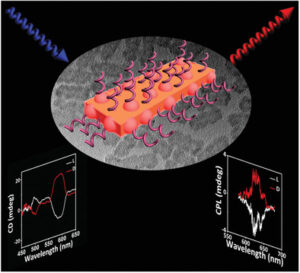
News: In this paper, chiroptical 2D CdSe/CdS nanoplatelets (NPLs) are prepared by ligand exchange approach, exhibiting both circular dichroism (CD) and circularly polarized luminescence (CPL). Furthermore, the CD and CPL signals are easily tuned via the design of the CdS-island structuration of the shell and its thickness which are controlled with the reaction time.
Laboratory : ICMCB

Ultrafast relaxation investigated by photoelectron circular dichroism: an isomeric comparison of camphor and fenchone

2021-11-26
News: Circular dichroism in the photoelectron angular distribution decays exponentially in ∼730 fs from a +9% forward amplitude during the first hundreds of femtoseconds to reach an asymptotic −2% backward amplitude after to have photoexcited at ~6 eV. This time-scale is drastically shorter than in fenchone, its isomer. Our analysis allows us to evaluate the impact of the anisotropy of excitation and reveal a breakdown of the Franck-Condon approximation.
Laboratory : CELIA