Chirality Expression from Hierarchical Foldamer-Mesoscopic Helical Silica Frameworks

2025-06-03
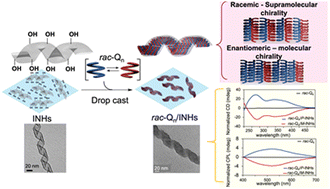
News: Chirality Expression from Hierarchical Foldamer-Mesoscopic Helical Silica Frameworks. We elucidate how chiral structures of vastly different sizes can interact and subsequently transfer their chiral information. Materials Chemistry Frontiers, 2025, 9, 1501 - 1510 https://doi.org/10.1039/D4QM01140F
Laboratory : CBMN-IECB_ISM

Webinar of the Optical and Neutron Spectroscopy Subdivision

The next webinar of the Optical and Neutron Spectroscopy Subdivision of the DCP will focus on “Spectroscopic Approaches to the Study of Molecular Chirality.”

Our two speakers will be:

  • Nicolas Daugey, Institut des Sciences Moléculaires, Bordeaux: “Raman Optical Activity: Principle and Application Examples.”
  • Etienne Rouquet, Université de Paris Saclay / Synchrotron SOLEIL: “Conformer-Selective and Photoelectron Circular Dichroism.”

Date: November 29, 2024, at 11:00 AM

Registration is required to receive the connection link at the following address:
https://cnrs.zoom.us/meeting/register/tJ0scuCopjgrHdZ4RQ5QHu1o4cs7ZOU2BbMx

We hope to see many of you there!

The SON Subdivision Committee


Dr. Marc Dussauze
CNRS Researcher
University of Bordeaux – Institut des Sciences Moléculaires
Bat. A12, 351 cours de la Libération, 33405 Talence CEDEX, FRANCE
Phone: (+33) (0)5 40 00 63 61
Email: marc.dussauze@u-bordeaux.fr
https://gsm.ism.u-bordeaux.fr/


Elucidating chirality transfer in liquid crystals of viruses

2024-05-30
News:
How does the propagation of chirality across various length scales take place?

It unfolds within the intricate playground of virus self-assemblies – used as model system of chiral particles – to form helical liquid crystals. These chiral liquid crystals exhibit a fascinating duality: simple in structure yet complex in behavior. This work explores the physical mechanisms governing chirality transfer for two distinct virus mutants, M13 and Y21M. Despite their high structural similarity, these viruses exhibit cholesteric liquid crystalline phase phases with opposite handedness. This seemingly apparent paradox stems from the subtle interplay between steric repulsion, chiral supramolecular virus deformations, and electrostatic forces.

For the stiff Y21M virus strain, the local electrostatic interactions, which are highly sensitive to both ionic content and the detailed atomic symmetries of the capsid, play a crucial role. In this case, the molecular chirality originates primarily from the subtle helical distribution of surface charges around the symmetry axes of the capsid.

In contrast, the chirality of the M13 virus arises from weak, fluctuation-induced suprahelical deformations of its backbone. This chirality transfer and the resulting helical phase are chiefly driven by steric interactions occuring at the supramolecular length scale of the viruses themselves.

Overall, this study provides a quantitative description of chirality transfer across different length scales. It reveals the complex interplay of competing chiral interactions with opposite signs, governing the emergence of chiral structures and helical morphologies.

Laboratory : CRPP

seminar of Prof. Yoshihiko Togawa (Osaka Metropolitan Univeresity) : A role of chirality: Generation and transfer of spin and phonon angular momenta

2024-07-05
News: We discuss a role of chirality in materials, being inspired by recent studies on chirality-induced selectivity of spin and phonon angular momenta with chiral materials. A comprehensive understanding of these nontrivial phenomena will clarify the interplay between structural and dynamical chirality.
when ? 05/07, 14h-15h
where ? IECB
Laboratory : CBMN

The 3 seminars

2024-05-14
News: Here are the 3 seminars delivered by Pr. Eiji Yashima in the upcoming month  :
  • On the 16th of May at 1:00 PM, a seminar will be held at LCPO on

    'Helical Polymers with Static Memory of Helicity'.

  • On the 21th of May during the journée GPR-LIGHT at IOA on

    'Double-Stranded Helical Foldamers with Unique Chiroptical Properties and Chiral Functions '

  • On the 24th of May during the KiNOA Day at IECB (at 9H05 AM)on

    'Helical Polymers with Static Helicity Memory: Synthesis and Applications'

About the Pr. Eiji Yashima: https://www.chembio.nagoya-u.ac.jp/labhp/polymer4/e/publication/pub_yashima.html
Laboratory : all laboratories

The third KiNOA’s day

24th of Mai 2024

INFORMATIONS : The kinoa-day will take place at IECB building.

Allotted time slots include a question and answer session, typically lasting 3 to 5 minutes, depending on the length of the presentations

PROGRAM :

  • 8h50-9h05 : Welcome
  • 9h05-9h50 : Eiji Yashima (Nagoya University) :Helical polymers with static helicity memory: Synthesis and applications
  • 9h50-10h05 : Victor Maurizot (CBMN) :Beta-sheet mimic foldamers
  • 10h05-10h20 : Robin Hess (CBMN) : Designing aromatic oligoamide cone-shaped carbohydrate receptors
  • 10h20-10h40 : Guillaume Gimenez (ISM) : Self-coacervation of polyampholytes for chiral separation of enantiomers

10h40 -11h10 : Coffee break/poster installation

  • 11h10-11h40 : Yann Mairesse (CELIA) : Laser-induced electron diffraction in chiral molecules
  • 11h40-12h10: Ludovic Jaubert (LOMA) :Chirality in magnetic crystals: from skyrmions to anomalous Hall effect

12h10-13h30 : lunch/discussions and poster’s presentation

  • 13h30-14h15 : Jeanne Crassous (ISCR, Rennes University) : Chirality and multifunctionality in helicene-based chemical platforms
  • 14h15-14h25: Anthony Boudier (CBMN/ISM) : Induction of chiroptical properties on achiral organic molecules at different scales, from nanometric to millimetric size
  • 14h25-14h35 : : Matheus Mendes (CBMN) : Template-assisted chirality induction to magnetic nanoparticles using silica nanohelices. Towards new magneto chiral responsive nanocomposites
  • 14h35-15h15 : Elizabeth Hillard/Nazanin Kordestani (ICMCB) : Recent adventures in X-ray optical activity
  • 15h15-15h45 : Eric Grelet (CRPP) : Origin of chirality transfer in virus self-assembly

15h45 -16h10 : Coffee break/posters

  • 16h10-16h40: Laurent Bouffier (ISM) : Circularly polarized electrogenerated chemiluminescence
  • 16h40-17h10: Vincent Rodriguez (ISM) :Hyper-Rayleigh and third-harmonic optical activity in chiral liquids

Autour du prix Nobel de Physique 2023, Physique Attoseconde : Genèse et Applications Récentes

Le 29 mars le Pr. Anne L’Huillier donnera une « Nobel Lecture » dans le cadre d’un Symposium « Physique Attoseconde : Genèse et Applications Récentes » sous l’égide du Département Sciences de la Matière et du Rayonnement. Le symposium se déroulera à L’Agora de 9h00 à 12h30 et sera suivi d’un cocktail déjeunatoire. Nous vous attendons nombreux à cet événement scientifique grand public qui permettra d’échanger avec la Pr. Anne L’Huillier.
Evènement gratuit avec inscription obligatoire via le framaform envoyé par email  le 08 mars 2024.

Inauguration du PEPR LUMA

Les 6 et 7 juin 2024 sera lancé officiellement le PEPR LUMA à Bordeaux. La communauté des interactions lumière matière se rassemblera pour l’inauguration institutionnelle et scientifique, incluant la présentation des Moonshot Projects (les résultats de l’AMI seront connus courant mars), du Hub Infrastructures LUMA, ainsi que le lancement des futurs appels à projets LUMA. Réservez les dates, l’événement est gratuit et largement ouvert à toutes et tous, nous espérons vous y voir nombreux ! Plus d’informations à venir.
https://www.pepr-luma.fr/