Electrochemiluminescent enantioselective detection with chiral-imprinted mesoporous metal surfaces

2022-12-15
News: Chiral-imprinted mesoporous Pt-Ir alloy surfaces were combined in a synergetic way with electrochemiluminescence (ECL) to detect the two enantiomers of phenylalanine (PA) as a model compound, acting simultaneously as a chiral target and as a co-reactant to generate significant differences in ECL signals. The chiral features of the metal surfaces are converted into an enantioselective electrogeneration of the excited state of the [Ru(bpy)3]2+ dye, which in fine produces the differentiating light emission with up to 20-fold differences in intensity for the two enantiomers. These findings open up the possibility of developing new ECL-based bioassays and microscopy of chiral environments.
S. Butcha, J. Yu, Z. Pasom, B. Goudeau, C. Wattanakit, N. Sojic, A. Kuhn
ChemComm 58 (2022) 10707-10710
Laboratory : ISM

Bipolar electrochemical rotors for the direct transduction of molecular chiral information

2022-12-15
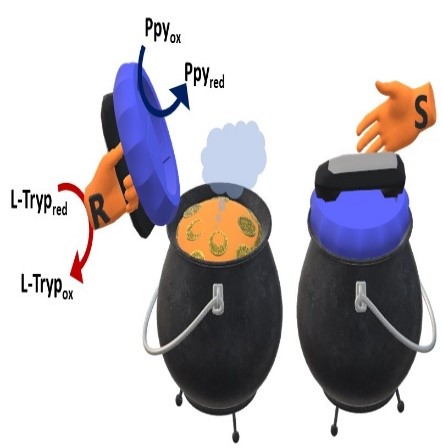
News: Efficient monitoring of chiral information of bioactive compounds has gained considerable attention, due to their involvement in different biochemical processes. In this work, we propose a novel dynamic system for the easy and straightforward recognition of chiral redox active molecules and its possible use for the efficient measurement of enantiomeric excess in solution. The approach is based on the synergy between the localized enantioselective oxidation of only one of the two antipodes of a chiral molecule and the produced charge-compensating asymmetric proton flux along a bipolar electrode. The resulting clockwise or anticlockwise rotation is triggered only when the probe with the right chirality is present in solution. The angle of rotation shows a linear correlation with the analyte concentration, enabling the quantification of enantiomeric ratios in mixtures where the two antipodes are present in solution. This device was successfully used to simultaneously measure different ratios of the enantiomers of 3,4-dihydroxyphenylalanine and tryptophan. The versatility of the proposed approach opens up the possibility to use such a dynamic system as a straightforward (bio)analytical tool for the qualitative and quantitative discrimination of different redox-active chiral probes.
S. Arnaboldi, G. Salinas, G. Bonetti, R. Cirilli, T. Benincori, A. Kuhn
Biosens. Bioelectron. 218 (2022) 114740
Laboratory : ISM

Wireless electromechanical enantio-responsive valves

2022-12-15
News: Microfluidic valves based on chemically responsive materials have gained considerable attention in recent years. Herein a wireless enantio-responsive valve triggered by bipolar electrochemistry combined with chiral recognition is reported. A conducting polymer actuator functionalized with the enantiomers of an inherently chiral oligomer was used as bipolar valve to cover a tube loaded with a dye, and immersed in a solution containing chiral analytes. When an electric field is applied, the designed actuator shows a reversible cantilever-type deflection, allowing the release of the dye from the reservoir. The tube can be opened and closed by simply switching the polarity of the system. Qualitative results show the successful release of the colorant, driven by chirality and redox reactions occurring at the bipolar valve. The device works well even in the presence of chemically different chiral analytes in the same solution. These systems open up new possibilities in the field of microfluidics, including also controlled drug delivery applications.
G. Salinas, F. Malacarne, G. Bonetti, R. Cirilli, T. Benincori, S. Arnaboldi, A. Kuhn
Chirality (2022) in press
Laboratory : ISM

Self-assembled monolayer protection of chiral-imprinted mesoporous platinum electrodes for highly enantioselective synthesis

2022-12-15
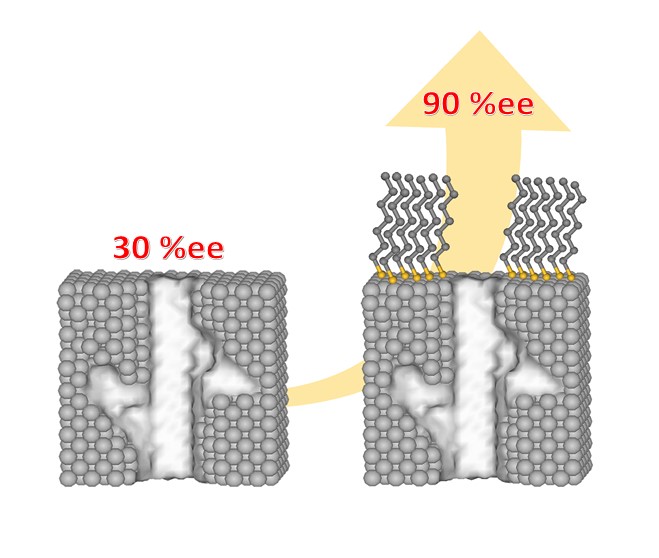
News: In modern chemistry, chiral (electro)catalysis is a powerful strategy to produce enantiomerically pure compounds (EPC). However, it still struggles with uncontrollable stereochemistry due to side reactions, eventually producing a racemic mixture. To overcome this important challenge, a well-controlled design of chiral catalyst materials is mandatory to produce enantiomers with acceptable purity. In this context, we propose the synergetic combination of two strategies, namely the elaboration of mesoporous Pt films, imprinted with chiral recognition sites, together with the spatially controlled formation of a self-assembled monolayer. Chiral imprinted metals have been previously suggested as electrode materials for enantioselective recognition, separation and synthesis. However, the outermost surface of such electrodes is lacking chiral information and thus leads to unspecific reactions. Functionalising selectively this part of the electrode with a monolayer of organosulfur ligands allows an almost total suppression of undesired side reactions and thus leads to a boost of enantiomeric excess to values of over 90% when using these surfaces in the frame of enantioselective electrosynthesis. In addition, this strategy also decreases the total reaction time by one order of magnitude. The study therefore opens up promising perspectives for the development of heterogeneous enantioselective electrocatalysis strategies.
S. Butcha, V. Lapeyre, C. Wattanakit, A. Kuhn
  Chem.Sci., 13, 2022, 2339
Laboratory : ISM

Two Prizes during JACC2022 conference

2022-10-06
News: Two prizes were delivered during JACC2022 :
  • Paola Matozzo (Univ. Rennes-PhD student at ISCR) for the poster  prize for her presentation on ''Exciton coupling chirality in helicene-porphyrin conjugates''
  • Nicolas Bruni (Univ. Bordeaux-PhD student at LOMA) for the young talk prize for his presentation on ''Directed morphogenesis of rewritable chiral liquid crystal supramolecular structures by chiral light''
 
Laboratory : JACC2022

GDR PES “Photo-Electro-Stimulation”

2022-10-20
News: The ISM will host the next symposium of the GDR PES "Photo-Electro-Stimulation". The goal of this GDR is to put together photochemists, spectroscopists and electrochemists to discuss about the interplay between these fields. The forthcoming symposium will take place from Monday 7th to Wednesday 9th of November at the ENSCBP school in Pessac. Here is the website to register: https://jpes.sciencesconf.org/ You should create an account prior to register in case you do not have already one. Registration is free but compulsory !
Laboratory : ISM

JACC2022

2022-10-06
News: Wonderfull week in a superb site with a top-level scientific program dealing with synthetic chemistry, materials architecture, spectroscopy of all kinds. 85 participants..... Thanks to all of them....with a special dedication to Patrick and Liz
Laboratory : ----